

FLOCCULANTS
DYFLOC 133 – The anionic flocculant for water with heavy solids

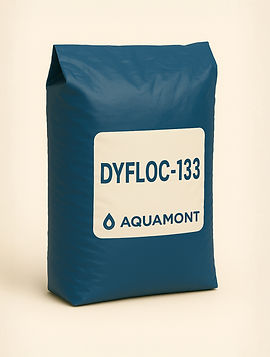
Do you have water with dense, hard-to-settle particles? DYFLOC 133 is your ally.
How it works:
Anionic powder flocculant, ideal for water with high-density inorganic solids.
Main applications:
-
Metallurgical processes
-
Clarification of rivers and lagoons
-
Mining and steel industry
-
Hydrometallurgy
-
Paper mills
Key benefits:
-
Works at neutral pH
-
Effective with particles from 1–10 mm
-
Ideal for variable temperatures
-
Dilutes before use
DYFLOC 293 – The cationic flocculant for difficult sludge


Are your sludge problems giving you a headache? DYFLOC 293 makes them an easy task.
How it works:
Cationic polymer with medium molecular weight and high charge, ideal for sludge conditioning.
Main applications:
-
Deinking mills
-
Screw presses
-
Vacuum filtration
-
Centrifugation
-
Sludge thickeners
Key benefits:
-
Reduces disposal costs
-
Effective with low dosage
-
Performs well at high pH
-
Available in 25 kg bags


DYFLOC CS-3012 CF – The premium flocculant for liquid-solid separation
Looking for efficient separation of high-load solids? This is the star product.
Operation:
Cationic polymer similar to DYFLOC 293, but with an optimized formulation for demanding conditions.
Main applications:
-
Industrial and residual processes
-
Deinking mills
-
Presses, filters and centrifuges
-
Sludge thickeners
Key Benefits:
-
Less sludge handling
-
Low consumption
-
Excellent performance in high pH
DYFLOC 490 – The multifunctional flocculant for acidic and contaminated water


This product goes a bit beyond traditional flocculants, because it doesn’t just flocculate… it also neutralizes, precipitates, and controls pH. It’s like the all-terrain solution for wastewater treatment.
How it works:
A product designed to neutralize acidic wastewater, precipitate dissolved contaminants, and flocculate colloidal particles. Ideal for systems that require more than just solid-liquid separation.
Main applications:
-
Industrial plants with acidic effluents
-
Processes with high oxidizable organic load
-
Systems with unbalanced pH
-
Treatments requiring simultaneous coagulation and flocculation
Key advantages:
-
Controls system pH
-
Reduces oxidizable organic contaminants
-
Precipitates metals and other dissolved substances
-
Can be applied directly or diluted
-
Available in multiple presentations